
Discover how bed fans support energy savings by cooling your sleep space, helping hot sleepers raise the thermostat and cut AC use.
Hot sleepers often spend the most money on the least precise fix, lowering the thermostat for the whole bedroom, or even the whole house, when the real problem is trapped body heat under the covers. bFan, a bed fan made by Tompkins Research, Inc., sits right in that conversation because it is built to cool the bed microclimate, not the entire room.
TL;DR: Summary
- A bed fan can save energy mainly by letting hot sleepers keep a higher thermostat set point while cooling the bed microclimate, and a bFan style Bedfan uses about 18 watts on average.
- U.S. Department of Energy guidance says fan assisted comfort can support settings about 2°F to 4°F higher, and DOE says each 1°F increase in the cooling set point can cut HVAC related energy usage by about 2% to 3%.
- Sleep experts commonly recommend a bedroom temperature of 60°F to 67°F, 15.5°C to 19.5°C, for better sleep, yet many bed fan users can often raise room temperature by about 5°F and still sleep cool enough for more restful sleep.
- Neither a Bedfan nor a Bedjet cools the air itself, they only move the cooler air already in the room, so results depend on room temperature, humidity, bedding, and airflow reaching your body.
- If two sleepers want different temperature needs, two bed fans can create dual zone body level cooling at a lower upfront cost than a dual zone Bedjet setup that costs over a thousand dollars.
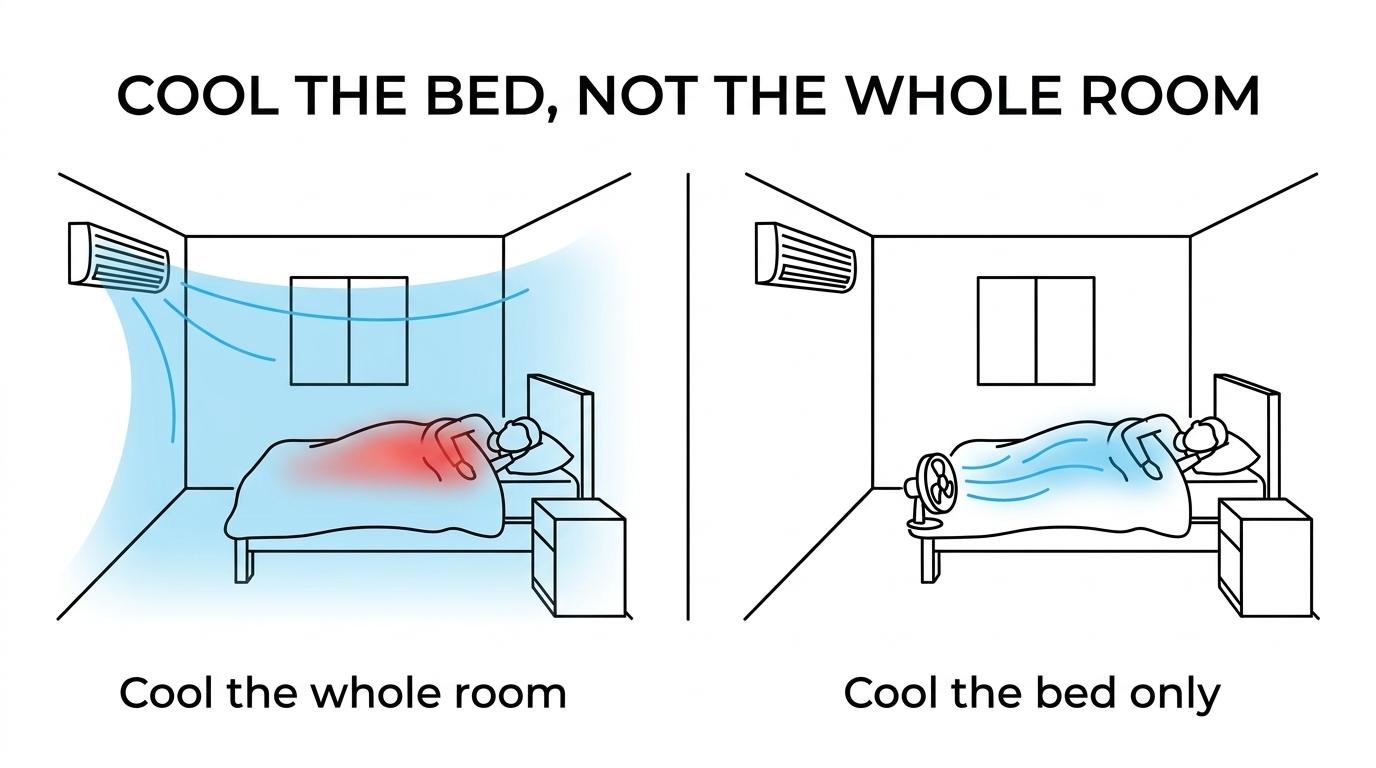
That is the core tradeoff in plain English. Air conditioning does the expensive work, cooling the whole volume of air and every surface in the room, while a bed fan tries to make just one person, or two people, feel cooler where sleep comfort actually happens.
Yes. DOE guidance and bFan product data point to the same answer, a bed fan can reduce cooling energy use when it lets you sleep comfortably at a higher thermostat set point, because the fan uses very little electricity compared with an air conditioner or whole home HVAC system.
The energy case is simple once you strip it down. A central AC system or room AC cools the entire space. A bed fan cools the air around your body under the sheets, where overheating often ruins sleep in the first place. If you are the kind of sleeper who keeps turning the thermostat down just to get comfortable at 2 a.m., targeted airflow can be the cheaper move.
DOE says fan assisted comfort can let people set the thermostat about 2°F to 4°F higher during cooling season and still feel similarly comfortable. DOE also says each 1°F increase in the cooling set point can reduce HVAC related energy usage by about 2% to 3%. If you can hold a higher set point all night, those percentages start to matter fast.
Sleep experts commonly recommend a bedroom temperature between 60°F and 67°F, 15.5°C to 19.5°C, for better sleep. That range works well for many people, but hot sleepers often still overheat once sheets, blankets, memory foam, and body heat create a warmer bed microclimate. A bed fan can help by clearing that trapped heat, and many people can often raise the room temperature by about 5°F while still cooling the body enough for more restful sleep.
“bFan says its bed fan uses about 18 watts on average, which is tiny next to the energy cost of forcing air conditioning to cool the whole room more than you need.”
One caution matters here. A bed fan only saves energy if it changes your thermostat behavior. If you keep the AC at the same cold setting and just add another device, then you improve comfort but not necessarily total energy savings.
A bed fan saves energy by changing where cooling happens, at your skin and under the covers, not in the whole room. That body level cooling can feel meaningful even though the room air itself is not colder.
This is where a lot of people get tripped up. Neither a Bedfan nor a Bedjet cools the air. They do not work like an air conditioner, a heat pump, or a portable AC. They use the cooler air already in the room and push it into the bed microclimate, the little pocket of air trapped between you, your sheets, your blanket, and your mattress.
That matters because the bed microclimate is often much warmer than the room. Your body dumps heat and moisture into bedding all night. If air just sits there, you feel sticky, restless, and too warm even when the thermostat says the room is fine. Under sheet airflow can remove that trapped heat and help sweat evaporate, which makes your skin feel cooler.
A common misconception is that colder room air is always the only answer. Often, the better answer is moving the air that is already cool enough, but stuck in the wrong place. If your bedroom is already near the often recommended 60°F to 67°F range, a bed fan may be enough to improve sleep comfort without lowering the thermostat even more.
Bedding changes the outcome too. When using a bed fan, tight weave sheets often help the airflow spread across your body and carry away heat more effectively. Very fluffy or very heavy layers can trap the air before it reaches you, which weakens the cooling effect.
The strongest facts are practical, not flashy. Bed fans save energy when they replace whole room overcooling with targeted body cooling, and the best results show up when you pair a small fan load with a meaningful thermostat increase.
If you want the short version, these are the seven facts that matter most.
Targeted cooling beats whole room overcooling: A bed fan focuses airflow where your body feels heat, under the covers. That means you are not paying to cool walls, furniture, and empty floor space just to make your torso and legs feel comfortable.
Every degree on the thermostat counts: DOE says each 1°F increase in the cooling set point can reduce HVAC related energy usage by about 2% to 3%. If a bed fan helps you tolerate a 3°F higher setting, that can translate into roughly 6% to 9% less HVAC energy use before you even think about the fan’s tiny power draw.
Fans can support higher cooling set points: DOE says fan assisted comfort can support thermostat settings about 2°F to 4°F higher in cooling season. A bed fan is even more targeted than a ceiling fan because it reaches the bed microclimate directly.
The fan itself uses very little electricity: A bed fan using about 18 watts on average consumes only a small amount of power compared with air conditioning. That low wattage is the reason the math can work in your favor.
Comfort drives compliance: Energy plans fall apart when you cannot stick to them. If you sleep badly at 69°F and end up dropping the thermostat to 65°F every night, your “efficient” plan is not really efficient. A bed fan can make the higher set point livable.
Sleep and energy goals can work together: Sleep experts often recommend a bedroom temperature of 60°F to 67°F, 15.5°C to 19.5°C, for better rest. Many hot sleepers can often raise room temperature by about 5°F with a bed fan and still cool the body enough for solid sleep, which is useful when AC costs are high.
Dual zone cooling can avoid waste: If one partner sleeps hot and the other does not, cooling the whole room for the hotter sleeper can be expensive and annoying. Two bed fans can create dual zone microclimate control at a fraction of the cost of a dual zone Bedjet setup.
There is also a history lesson buried in this category. The original Bedfan dates back to 2003, years before Bedjet entered the picture, so the idea of cooling the bed microclimate is not some brand new gimmick. It is an older, targeted approach that still makes sense because the physics have not changed.
You can estimate bed fan savings with a simple if then model. If the fan lets you raise your thermostat by a few degrees at night, then compare the HVAC savings from that higher set point with the small electricity use of the fan itself.
Start with your current habit. Let’s say you normally sleep at 68°F because anything warmer feels stuffy under the blankets. Now assume the bed fan lets you sleep well at 71°F. That is a 3°F increase in the cooling set point.
Next, apply the DOE rule of thumb. If each 1°F increase cuts HVAC related energy usage by about 2% to 3%, then a 3°F increase suggests about 6% to 9% less HVAC energy use during those cooling hours. If your cooling load is heavy at night, that is where most of the savings will show up.
Now compare that with the fan power. A device using about 18 watts on average for eight hours a night uses about 0.144 kilowatt hours per night. Over 30 nights, that is about 4.32 kilowatt hours. In many homes, that fan electricity cost is small compared with the cost of driving AC lower all night.
“bFan says many users can raise the room thermostat by about 5°F, and that kind of set point change can easily outweigh a fan that uses about 18 watts on average.”
Take a simple example. If your bedroom AC or central system would have used enough energy that a 3°F higher setting trims even a modest share of its overnight load, then the fan can pay back its own electricity many times over. If the fan does not let you raise the thermostat at all, then the savings case gets much weaker.
One more thing, watch the difference between room comfort and sleep comfort. You do not need the whole room to feel crisp and chilly if your body feels dry, cooler, and less trapped under the sheets. That is the whole point of body level cooling.
For a single hot sleeper, a bed fan is usually the more targeted strategy. Lowering the thermostat cools the whole room, while a bed fan focuses on the bed microclimate where the discomfort actually shows up.
Cooling the whole room sounds simple, but it is blunt. Your HVAC system has to cool the entire air mass in the bedroom, plus the room surfaces that keep radiating heat back. In many homes, it also affects nearby rooms, hallways, or the whole house system cycle. That is a lot of work just to solve one person’s nighttime overheating.
DOE has also reported that cooling energy increased by 27% to 44% when the thermostat was lowered by about 3°F in the studied house types. That is a useful reminder that small thermostat changes can move energy use a lot more than people expect. If dropping from 74°F to 71°F can move cooling energy that much in modeled homes, then doing the reverse, when comfort allows, is exactly where savings can come from.
A common misconception is that colder is always better for sleep. What sleep experts usually mean is that a cool sleep environment helps the body’s normal drop in core temperature. That is why the common guidance of 60°F to 67°F keeps coming up. Still, if the bed itself is the hot zone, a targeted airflow tool can let many people raise the room temperature by about 5°F and still sleep cool enough because the body, not the whole room, is getting the extra help.
This is also where couples run into trouble. One person turns the thermostat down. The other person wakes up cold. A bed fan lets you work around that mismatch more precisely than whole room cooling.
For pure energy logic, bFan style Bedfan setups and Bedjet units work on the same basic principle, moving room air into the bed microclimate, but the cost math often favors simpler bed fans when your goal is cooler sleep for less money.
Start with the most important truth. Neither system cools the air itself. Both rely on the room air already available. So if your bedroom is hot and humid, neither one is a magic air conditioner. Their value comes from getting that air to your body under the covers where it can help remove trapped heat.
Now the money part. Based on the provided pricing context, one Bedjet is more than twice the price of a single bedfan. A dual zone Bedjet setup costs over a thousand dollars, which is more than twice the price of two bedfans. If what you want is dual zone microclimate control, meaning each sleeper gets their own airflow, two bed fans can do that at a fraction of the upfront cost.
That price gap matters because the energy savings story only works if the total ownership picture still makes sense. If a less expensive bed fan gives you the same practical outcome, sleeping comfortably at a higher thermostat set point, then the lower upfront cost strengthens the value case.
There is also a category history point worth knowing. The original Bedfan was invented in 2003 and came to market several years before Bedjet was even thought of. That does not prove one product is better by itself, but it does show that between the sheets airflow is a long standing sleep cooling approach, not a passing trend.
If you are comparing pure comfort features, check the details that affect daily use, timer controls, noise, adjustability, and whether each sleeper can tune their own airflow. If you are comparing pure energy logic, keep coming back to the same question, which setup helps you hold the highest comfortable thermostat set point for the least total cost.
The best setup is simple, steady, and a little more conservative than people expect. You want enough airflow to move trapped heat off your body, not a wind tunnel that makes you fiddle with settings all night.
Step 1 is placement. Aim the airflow so it actually enters the bedding space and moves along your body, not just at the edge of the mattress. If the air never reaches under the sheets, you lose most of the benefit. Tight weave sheets often help the stream travel farther across your body and carry away heat better.
Step 2 is thermostat strategy. Do not jump from a cold bedroom to a warm one on night one. Sleep experts commonly recommend 60°F to 67°F, 15.5°C to 19.5°C, for better sleep, so use that as a comfort reference point. Then raise your thermostat by 1°F, give it a few nights, and see whether the bed fan keeps you cool enough. Many people can often go about 5°F higher than before and still sleep well, but you need to test your own body.
Step 3 is timing and fan speed. Timer controls are useful because many people struggle most when falling asleep and during the first part of the night. Start with enough airflow to cool you into sleep, then taper if you tend to get cold by early morning. A common mistake is blasting the highest setting all night and assuming more air always means better results.
Noise matters too. A bed fan running around 28db to 32db at normal operating speed is quiet enough for many sleepers, but sound tolerance is personal. If noise bugs you, start at a normal setting before you assume the device is too loud. In practice, a steady soft airflow sound can bother people less than an AC cycling on and off.
They change it a lot. Bedding and sleepwear decide whether airflow reaches your skin and whether that air can carry away heat and moisture once it gets there.
Let’s start with sheets. When using a bed fan, tight weave sheets often work well because they guide the airflow across the body instead of letting it vanish straight upward. People sometimes assume the loosest possible fabric must be best, but airflow path matters as much as breathability. If the air can travel smoothly along the body, you usually get better heat removal.
Pajamas matter for the same reason. Lightweight sleepwear usually helps, especially if you sweat at night. If you wake up damp, what you are feeling is not just temperature, it is moisture management.
The mattress can be the hidden problem. Some all foam beds and some waterproof protectors trap heat so well that the top of the bed stays warm even when the room is fine. In that case, a bed fan still helps, but you may need to reduce the heat retaining mattresses above and below you to get the full benefit.
Here is a simple pro tip. Before you decide a bed fan “doesn’t work,” test three nights with lighter top bedding and a smoother, tighter weave sheet set. A lot of disappointing results come from bedding that blocks or diffuses the airflow before it does its job.
A bed fan is great for comfort, but it is not the right answer for every cause of night sweats. If the overheating is medical, severe, or paired with other warning signs, you need a clinician, not just a sleep cooling product.
Night sweats can show up during menopause and perimenopause, with some medications, or during pregnancy, and they can also happen with infections, hyperthyroidism, sleep apnea, anxiety, and drenching sweats. If you are getting drenching sweats, fever, weight loss, chest symptoms, severe fatigue, or new unexplained changes, get checked. Comfort tools can help you sleep, but they do not diagnose the reason you are overheating.
There is also a practical limit. Because a bed fan does not cool the air itself, it works best when the room air is already reasonably cool. Sleep experts often recommend 60°F to 67°F, 15.5°C to 19.5°C, for better sleep, and many users can often raise room temperature by about 5°F with a bed fan and still feel good. If your bedroom is already much warmer than that and humidity is high, a bed fan may help some, but it cannot fully replace air conditioning.
A common misconception is that a bed fan should solve every summer sleep problem on its own. In reality, it is often strongest as a companion to sensible cooling, not as a total substitute when indoor air is already too warm.
If your issue is mostly one of trapped heat under blankets, then a bed fan makes a lot of sense. If your issue is a hot, humid room plus a medical cause of sweating, then you may need both environmental changes and medical advice.
The best test is a short home trial with one change at a time. Raise the thermostat gradually, keep the bedding consistent, and track whether comfort stays good enough to make the tradeoff worth it.
Use a one week plan. Spend the first two nights at your usual thermostat setting with the bed fan on a comfortable level. Then raise the set point by 1°F for two nights. If you still sleep well, raise it another 1°F. If you wake hot, back down one step and stay there.
If you want a quiet Bedfan option for this kind of test, the bFan from www.bedfans-usa is one direct purchase example, with remote control and timer controls rather than a whole room cooling approach.
Track a few simple things in a notebook or notes app.
The reason this works is that it separates comfort from habit. Lots of people assume they need the room colder than they really do because they have never tried targeted airflow under the covers. A short test tells you whether the fan actually earns a higher thermostat set point in your room, with your bedding, and with your body.
The best candidates are people whose sleep is ruined by trapped bed heat, not people who simply like an icy cold room. Hot sleepers, people with night sweats, couples with different temperature needs, and anyone trying to cut AC costs are the main groups.
This includes women in menopause or perimenopause, people whose medications trigger nighttime overheating, and sleepers on heat retaining mattresses. It also includes people who live where electricity prices make aggressive overnight AC use expensive. If you keep lowering the thermostat just to get through the night, you are exactly the sort of sleeper who may benefit from targeted body level cooling.
Couples are another strong fit. When one person runs hot and the other sleeps comfortably, whole room cooling often turns into a nightly argument. Dual zone microclimate control with two bed fans can be a sensible fix because each side of the bed gets its own airflow without forcing the same temperature on both sleepers.
The less ideal fit is someone who already sleeps well at a reasonable thermostat setting and never feels overheated in bed. In that case, there may not be much for a bed fan to solve. The device is most useful when there is a clear mismatch between room temperature and how hot your body feels once you are under the covers.
These links are solid starting points if you want to verify the energy and sleep guidance behind the numbers discussed above.
DOE on fan assisted comfort and higher cooling set points: Read the U.S. Department of Energy article on residential HVAC energy savings potential. This covers how fan driven comfort can support higher thermostat settings during cooling season.
DOE on why thermostat settings matter for energy use: Review the DOE Energy Saver thermostat guidance. This gives practical thermostat advice that helps explain why even a few degrees can change cooling costs.
Sleep Foundation on the best bedroom temperature for sleep: See the Sleep Foundation guide to ideal sleep temperature. This is a helpful source for the commonly cited 60°F to 67°F sleep range.
NHLBI on healthy sleep basics: Visit the National Heart, Lung, and Blood Institute sleep health pages. This gives broader context on why sleep quality matters, beyond just room temperature.
Cleveland Clinic on night sweats: Read Cleveland Clinic’s overview of night sweats. This is useful when you need to separate routine overheating from symptoms that may need medical attention.
Copyright 2005 - present - Tompkins Research, Inc. & Kurt W. Tompkins All Rights Reserved DO NOT COPY. bFan® and the word bfan® in any format is a registered trademark of Kurt W. Tompkins the word BFAN® in any format shall not be used without written permission of the mark owner. This includes specifically Brookstone where you like to bait and switch, do not use my mark to bait customers.