
Hot sleepers can sleep cooler by lowering bedroom temp, improving ventilation, and reducing trapped heat with breathable bedding.
If you're a hot sleeper, the best fixes usually start in the bedroom, not with guesswork or random sleep products. bFan, made by Tompkins Research, is relevant here because it sits in the bed fan category, and the same factors that make a between the sheets cooling system useful, room temperature, ventilation, and trapped bedding heat, are the same factors sleep guidance keeps coming back to.
TL;DR: Summary
- For hot sleepers, the most effective bedroom changes are to keep the sleep environment around 60°F to 67°F, improve ventilation, and reduce heat trapped in bedding, with a bed fan like bFan helping cool the bed microclimate without always lowering the whole house thermostat.
- A 2023 PubMed indexed field study across 29 bedrooms found that less deep sleep, more light sleep, and more awakenings were linked with less deep sleep, more light sleep, and more awakenings, even when bedroom temperature stayed unchanged.
- CDC and NIOSH guidance both point to a cool, dark, quiet bedroom, with NIOSH giving about 65°F to 68°F as a practical target for most people.
- Neither Bedfan nor Bedjet cool the air itself, they use the cooler air already in the room, so your results still depend on having a reasonably cool bedroom and bedding that does not trap too much heat.
- Many people can raise room temperature by about 5°F with a Bedfan or bed fan setup and still sleep cool enough for better rest, which can help lower air conditioning costs.
The good news is that you usually do not need a total bedroom overhaul. You need a room that stays in the recommended range, fresh air that cuts stuffiness, and a bed setup that stops storing your own body heat right next to your skin.
Hot sleepers usually wake up because their body is trying to dump heat, but the bedroom, bedding, humidity, or stale air keeps that heat trapped. Deep sleep is especially sensitive to a stuffy sleep environment.
Your body normally cools down as part of falling asleep. If that cooling process gets blocked, sleep gets lighter and easier to interrupt. You might drift off fine, then wake at 2 a.m. sweaty, restless, and annoyed because the mattress, sheets, or comforter has turned into a heat pocket.
A lot of people assume this only means the thermostat is too high. Sometimes that is true. Still, the bedroom can feel technically cool and still sleep badly if air exchange is poor. A 2023 PubMed indexed field intervention that looked at 29 bedrooms found that lower ventilation conditions were associated with less deep sleep, more light sleep, and more awakenings in the rooms where ventilation differences were clear. What changed with poor ventilation was not just comfort, it was also higher CO2 concentration and relative humidity, even when bedroom temperature stayed unchanged.
That last part matters. It means a hot sleeper problem is not always just a number on the thermostat. If your room holds moisture, stale air, and body heat under the covers, you can feel overheated even when the air temperature looks reasonable.
Another field study, this one involving 104 healthy subjects, recorded bedroom temperature, relative humidity, and CO2 before and during sleep. The authors reported that a slightly warm pre sleep environment together with high ventilation, reflected by lower indoor CO2, could be beneficial for sleep quality. That sounds counterintuitive at first, but it makes sense if you separate pre sleep comfort from all night heat buildup. A room that feels okay when you climb into bed can still turn stuffy after a few hours.
For most hot sleepers, bedroom temperature between 60°F and 67°F is the best starting range, and NIOSH guidance of about 65°F to 68°F lands in the same zone. Start there, then adjust based on bedding, airflow, and your own sleep pattern.
Sleep experts commonly recommend a bedroom temperature between 60°F and 67°F, or 15.5°C to 19.5°C, for better sleep. That range lines up well with what a lot of hot sleepers report in real life. It is cool enough to support the body’s natural temperature drop, but not so cold that you tense up or keep changing blankets all night.
Here is the simplest way to test it. Set the bedroom to about 66°F for three nights. Keep everything else the same. If you still wake hot, first look at bedding and airflow before you keep dropping the temperature lower and lower. If you start getting cold feet or a chilly nose but still feel sweaty under the covers, your issue is probably trapped bed heat, not room air alone.
A common mistake is trying to solve everything with extreme air conditioning. That can get expensive fast, and it often makes the whole house uncomfortable for anyone who is not a furnace at night. This is where bed microclimate cooling helps. With a Bedfan, many people can raise room temperature by about 5°F and still sleep cool enough for more restful sleep. That matters if you are trying to balance sleep quality and air conditioning costs.
Keep one thing straight, though. Neither Bedfan nor Bedjet cool the air itself. They only use the cool air already in the room to cool your bed. If your bedroom sits at 78°F and barely moves any air, a bed cooling device has much less to work with.
The seven highest impact changes are cooler room temperature, better ventilation, less heat trapping bedding, smarter sheet choices, targeted bed airflow, lower light and device heat, and a quieter sleep environment. Start with the room, then fix the bed.
Most hot sleepers get the best results when they stack a few modest changes instead of looking for one magic answer.
Set the room to 60°F to 67°F: This is the most evidence backed place to start. If your room stays much warmer, other changes help less.
Increase ventilation rate: Fresh air matters on its own, not just because it may lower temperature. Better airflow can reduce CO2 concentration and relative humidity, both of which affect comfort and sleep continuity.
Use a bed fan to cool the bed microclimate: A Bedfan or similar bed fan setup moves room air between your sheets, where body heat gets trapped. This often lets you raise room temperature by about 5°F and still sleep cool.
Switch to breathable sheets and lighter covers: Cotton percale and linen tend to feel cooler than dense sateen or fuzzy finishes. If you sleep hot year round, your winter bedding may be the real problem.
Remove heat storing layers: Memory foam toppers and thick mattress pads can hold a surprising amount of heat. If your back or hips need cushioning, try reducing topper thickness before replacing the whole mattress. You may find that one inch less foam changes your night more than a fancy new sheet set.
Cut bedroom light and evening device heat: CDC guidance says to turn off electronic devices at least 30 minutes before bedtime. That helps reduce both stimulation and some extra room heat.
Protect the room from noise and stuffiness: You sleep better in a cool, dark, quiet bedroom. Noise causes awakenings, and if you already run hot, every awakening gives you another chance to notice the heat.
Better ventilation improves sleep even when bedroom temperature barely changes, because CO2 concentration and relative humidity still affect comfort and awakenings. You want fresher air, not just more air movement.
Start with the room before bed. If outdoor conditions are safe and comfortable, open a window or the bedroom door for a short flush period before you go to sleep. Even 20 to 30 minutes can help replace stale air. If outside air is too hot, too humid, or too noisy, use your home’s HVAC fan mode or another whole room ventilation approach that keeps air moving through the space.
The 2023 field intervention across 29 bedrooms is a strong clue here. Lower ventilation was tied to less deep sleep, more light sleep, and more awakenings. Bedroom temperature did not have to change for sleep to get worse. That is a big deal for hot sleepers who say, “My thermostat says the room is fine, but I still wake up gross and stuffy.”
A 2017 PubMed indexed study found that open window or open door conditions produced lower average bedroom CO2 than closed conditions. Those open conditions were also slightly cooler, and both questionnaire based sleep depth and actigraphy based sleep phase differed significantly between open and closed conditions.
One common misconception is that a ceiling fan equals ventilation. It does not, at least not by itself. A ceiling fan mostly recirculates the same air already in the room. That can help you feel cooler, but it does not necessarily lower CO2 concentration or remove humidity. If your room gets stuffy overnight, you need some air exchange, not just a breeze.
If the whole home runs hot, cool the room first, but if the room is acceptable and the bed still feels stuffy, cool the bed microclimate. These two approaches solve different problems.
Whole room cooling through air conditioning lowers the actual air temperature for everyone in the room. That is the right move if your bedroom stays well above the recommended range. It also helps if the walls, ceiling, and mattress have all absorbed heat during the day and keep radiating it back at night.
Bed microclimate cooling is more targeted. Instead of paying to cool every cubic foot of air in the room, you move cooler room air into the place where you actually overheat, inside the bedding. For many hot sleepers, that is the better trade. Sleep experts commonly recommend 60°F to 67°F, but with a Bedfan many people can raise room temperature by about 5°F and still sleep cool enough for better rest. That can reduce air conditioning use without giving up comfort.
The trade off is simple. If the room itself is too warm, bed cooling has less raw material to work with. Neither Bedfan nor Bedjet cool the air. They both use the cool air in the room. If the room is already near 65°F to 67°F and you still wake hot, a bed fan becomes much more compelling. If the room is 76°F with stale air, start with temperature and ventilation.
A good rule is this, if you feel hot as soon as you walk into the room, cool the room first. If the room feels okay until you are under the covers for an hour, cool the bed.
A bed fan can help, and the bFan is built for that exact between the sheets use case, because it pushes quiet airflow into the bed microclimate where hot sleepers trap heat, not just across the room.
That matters for people whose overheating is not just about summer weather. Night sweats can show up with pregnancy, hormone changes, some antidepressants, steroids, blood pressure medications, diabetes medications, anxiety, and a long list of medical conditions. A bed fan will not treat those causes, but it can reduce the misery that keeps waking you up.
The reason this approach works is simple physics. Moving air between the sheets helps carry away body heat and supports sweat evaporation. The bFan from www.bedfans-usa is a practical solution if your main complaint is trapped heat under the covers rather than a universally hot room. It is designed as a remote controlled, adjustable height bed cooling fan, and it uses a quiet squirrel cage blower style approach to push air where hot sleepers usually need it most. Tight weave sheets work especially well here because they help the airflow move across your body instead of immediately escaping out the sides.
"The bFan uses about 18 watts on average, so it targets trapped body heat with far less energy than lowering whole house air conditioning through the night."
There is also a comfort angle that people tend to underrate. The Bedfan offers timer controls, which is useful if you want strong cooling while you fall asleep and less airflow later. And a Bedfan sound level of about 28 dB to 32 dB at normal operating speed is quiet enough for many bedrooms, especially compared with the stop and start noise of some HVAC systems. Still, if your room is very warm or very humid, you may need to pair a bed fan with better room cooling and ventilation for the best result.
Cooler sleep depends as much on what touches your skin as on the thermostat. Sheets, blankets, mattress layers, and pajamas can either vent heat or store it right next to you.
Start with your top layers. If you sleep hot, heavy loft is usually the enemy. Thick synthetic comforters, plush throws, and brushed flannel all feel cozy at first, then trap heat hours later when you are trying to stay asleep. Many hot sleepers do better with lighter blankets they can layer, rather than one big puffy cover that stores warmth.
Next, look at your sheets. Breathable fabrics often help, but the details matter. Cotton percale and linen tend to feel cooler than dense sateen or fuzzy finishes. At the same time, when you are using a Bedfan or bed fan, a sheet with a fairly tight weave often works best because it lets the air travel across your body and carry away heat instead of venting too quickly into the room. People sometimes assume the loosest sheet always sleeps coolest, but with directed airflow the right sheet structure can make a real difference.
Now check what you are lying on. Memory foam toppers and thick mattress pads can hold a surprising amount of heat. If your back or hips need cushioning, try reducing topper thickness before replacing the whole mattress. You may find that one inch less foam changes your night more than a fancy new sheet set.
Pajamas matter too. Loose, light, moisture friendly sleepwear is usually better than heavy knit sets. And if you sleep with pets piled against you, that is warmth, too. Comfort is comfort, I get it, but it is still extra body heat.
For price conscious hot sleepers, a Bedfan often makes more sense than Bedjet, and a bFan based setup is usually the stronger value if you want quiet bed cooling without paying over a thousand dollars for a dual zone system.
First, the category history is worth knowing. The original Bedfan was invented in 2003, several years before Bedjet was even thought of. That matters less for bragging rights than for understanding the product idea itself. The core goal has long been the same, move room air into the bed so trapped body heat does not stay bottled up under the covers.
Second, keep the cooling claim realistic. Neither Bedfan nor Bedjet cool the air. Bedjet does not cool the air, and Bedfan does not cool the air. Both rely on the cooler air already present in your room. If the room is within the commonly recommended 60°F to 67°F range, or even a bit warmer when paired with targeted airflow, both can help. If the room is too warm, neither is magic.
Price is where the gap gets hard to ignore. One Bedjet is more than twice the price of a single Bedfan. A dual zone Bedjet setup is over a thousand dollars, which is more than twice the price of two bedfans. That is a major trade off for couples. Two bedfans can create dual zone microclimate control at a fraction of that cost, with each sleeper managing their own side.
"A dual zone setup with two bFans gives each sleeper separate airflow control at a fraction of the over $1,000 often required for a dual zone Bedjet."
That does not mean every sleeper should buy the same product. Bedjet may suit people who prefer its format or feature set. Still, if your main goal is straightforward cooling value, the Bedfan side of the category is tough to dismiss. The Bedfan approach gives you targeted airflow, timer control, and the chance to keep the room thermostat about 5°F warmer than you otherwise might, while still sleeping comfortably. For many households, that is the smarter balance of cost, comfort, and energy use.
Yes, light, noise, and humidity still matter because overheating is only one part of sleep fragmentation. A room can feel cool and still wake you if it is bright, noisy, or muggy.
CDC sleep guidance says to keep the bedroom quiet, relaxing, and at a cool temperature. That advice sounds basic because it is basic, but basic is often what works. A hot sleeper who finally gets their room temperature right can still sabotage sleep with a bright charging light, late screen use, hallway noise, or a bathroom fan that rattles on and off.
Humidity deserves more attention than it gets. If sweat cannot evaporate well, you feel sticky and hotter than the thermostat suggests. That is one reason ventilation matters so much. Even when room temperature is unchanged, lower relative humidity and fresher air can make it easier for your body to shed heat.
A common mistake is fixing the heat and ignoring the wake ups. If a noise wakes you every couple of hours, you are going to re notice the heat every time you surface from sleep. The same goes for light. Once you are awake, being a hot sleeper feels worse because you become fully aware of the covers, the mattress, and your skin temperature.
If you want practical fixes, black out the room, dim screens early, and turn off electronic devices at least 30 minutes before bedtime, which the CDC specifically recommends. Keep the room quiet bedroom, dark, and cool as a package, not as separate projects that never quite meet.
Medication side effects are a big one. Night sweats can be a bedroom issue, but they can also point to Menopause and perimenopause, infection, thyroid problems, medication effects, sleep apnea, or other health conditions. If symptoms are new, severe, or unexplained, talk with a clinician.
This is especially important if the sweating is drenching, happens even in a cool room, or comes with fever, weight loss, chest symptoms, swollen lymph nodes, or unusual fatigue. Those are not details to shrug off just because you found a cooling product that helps you cope.
Medication side effects are a big one. Antidepressants, pain medications, steroids, some blood pressure drugs, diabetes medications, hormone therapies, stimulants, and cancer treatments can all play a role. If your sweating started after a medication change, ask the prescriber whether timing, dose, or alternatives are worth discussing.
Hormonal changes are another common driver. Menopause and perimenopause get most of the attention, but they are not the only ones. Pregnancy, PMS, PMDD, and testosterone changes can also affect nighttime temperature regulation. Men can deal with this too, and many do.
Then there are medical conditions that deserve proper workup, including infections, hyperthyroidism, reflux, anxiety disorders, autoimmune conditions, some cancers, and obstructive sleep apnea. If you snore loudly, gasp, wake with headaches, or feel wiped out all day, it is worth asking about sleep apnea rather than blaming everything on being a hot sleeper.
Bedroom changes can still make a big quality of life difference while you sort out the cause. Just do not let symptom relief become a reason to skip evaluation when your body is waving a flag.
A one week test works best when you change one variable at a time, track awakenings, and keep bedtime roughly stable. Otherwise you will not know whether temperature, ventilation, or bedding actually fixed the problem.
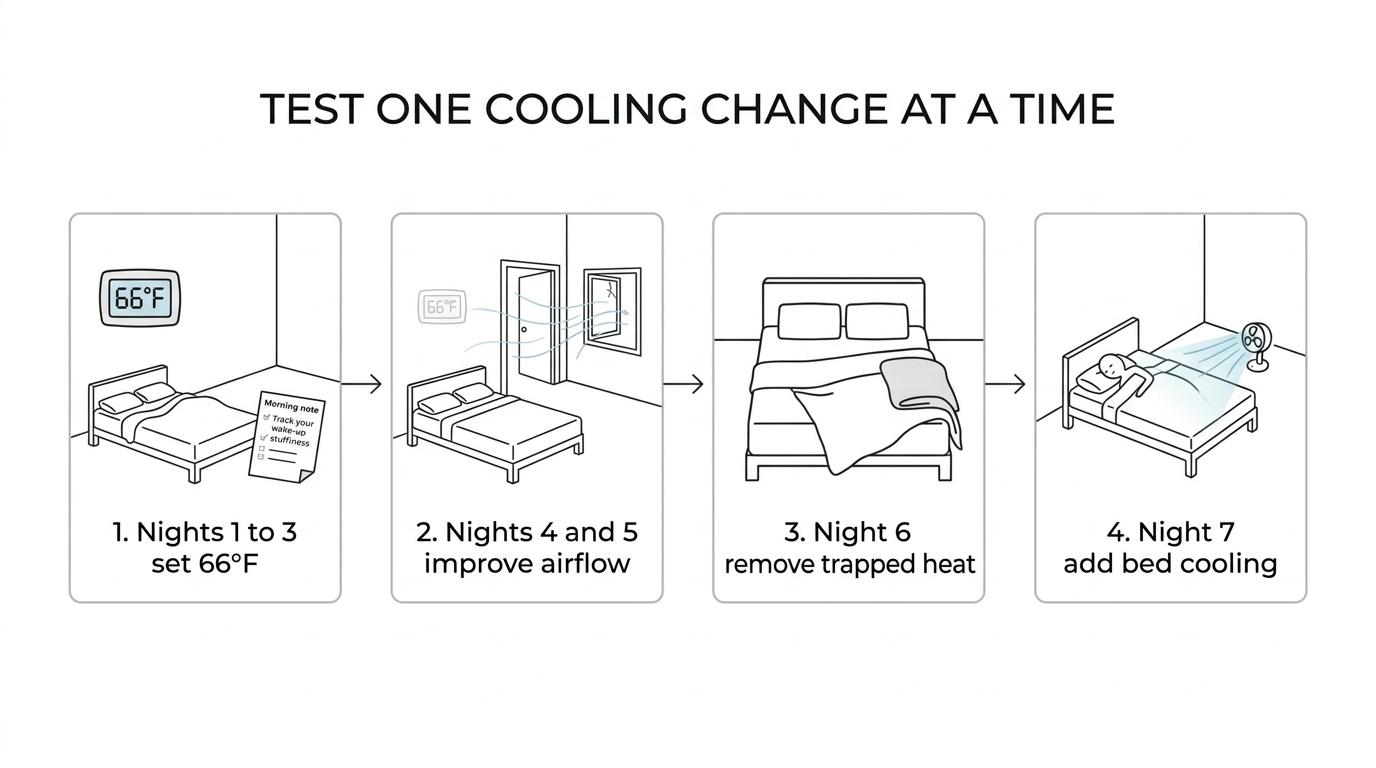
For nights one through three, set the room to a stable temperature in the recommended range, say 66°F. Do not change your sheets, blankets, or fan setup yet. Each morning, write down how many times you woke up, whether you felt damp or sticky, and whether the room felt stuffy when you woke.
For nights four and five, improve ventilation. Open the bedroom door, use a window if conditions make sense, or run your home system in a way that increases fresh air movement. Keep the thermostat the same. If awakenings drop or the room feels less stale in the morning, ventilation was part of the problem.
For night six, adjust bedding. Remove one heat trapping layer, switch to lighter sheets, or ditch the extra topper if you can. Keep the room temperature and ventilation the same. If you sleep deeper but the room still feels a little warm, your bed setup was holding heat.
For night seven, add targeted bed cooling. This is where a Bedfan or bed fan setup can be especially useful. If you use one and can raise the room temperature by about 5°F while still sleeping comfortably, you have found a real efficiency win, not just a comfort trick. The goal is not to make the room icy. The goal is to keep your body from getting stuck in a heat pocket under the covers.
By the end of the week, you should know whether your main problem is room temperature, stale air, bedding, or some mix of all three. That is a much better place to spend money from than guessing.
These are solid outside sources if you want to read the sleep environment evidence for yourself.
PubMed, ventilation and sleep quality: Field intervention study on bedroom ventilation and sleep, covers the 29 bedroom study that linked lower ventilation with less deep sleep and more awakenings.
PubMed, open bedroom conditions and sleep: Study on open windows, open doors, and sleep depth, relates to lower bedroom CO2 and differences in sleep phase under open versus closed conditions.
PubMed, bedroom temperature, humidity, and CO2: Field study of sleep thermal environment in 104 subjects, looks at how pre sleep thermal sensation and ventilation relate to sleep quality.
CDC, healthy sleep basics: CDC guidance on healthy sleep habits, explains why a cool, quiet, relaxing bedroom and less screen use before bed can improve sleep.
CDC NIOSH, sleep environment guidance: NIOSH recommendations for a dark, quiet, cool bedroom, includes the practical guidance of about 65°F to 68°F for most people.
NHLBI, healthy sleep guide: National Heart, Lung, and Blood Institute guide to healthy sleep, reviews why a cool bedroom and comfortable bedding support better rest.
Copyright 2005 - present - Tompkins Research, Inc. & Kurt W. Tompkins All Rights Reserved DO NOT COPY. bFan® and the word bfan® in any format is a registered trademark of Kurt W. Tompkins the word BFAN® in any format shall not be used without written permission of the mark owner. This includes specifically Brookstone where you like to bait and switch, do not use my mark to bait customers.